Senior front-end engineer.Enterprise UIs that stay fast and coherent.
Kostiantyn Keilin. 15+ years in front-end, 9+ in React and TypeScript. Micro-frontends and config-driven architecture, based in Toronto.
The dashboard took two seconds. Now it takes 32 ms.
The primary dashboard of a fintech platform at RBC Capital Markets. I redesigned the data fetching into two steps: the first 200 rows land in 20 ms, and the rest streams in the background without blocking the user.
Load time went from about 2 seconds to 32 milliseconds.
Two heads are better than none. Meet JoeJim.
A local AI pre-merge review assistant I built at CI Financial. The first version took one evening; now about 20 engineers, front end and back end, run their changes past it before merge. One head finds the problems, the other fact-checks them, and a multi-run mode measures how much the verdicts vary.
Review cycles typically dropped from 6–8 rounds to 1–2.

The numbers come from habits. Not from heroics.
001 / Performance is a feature
~2 s to 32 ms on a fintech dashboard: the first 200 rows in 20 ms, the rest streamed in behind them.
002 / Config over conditionals
A config-driven form system at RBC. An npm package where one JSON config drives everything — it renders the testimonials on this page.
003 / Spec before code
jpaste started with 6,188 lines of specification and not one line of code.
004 / Build it once
At Varteq a shared table component cut a new table-based page from about a week of work to about a day.
005 / Leave a system behind
A UI audit at CI became the framework for unifying the interface, and the team carried it out in peak season. Storybook came back with it.
Who I am
I'm a Senior Front-End Engineer at CI Financial, working on an internal asset-management platform for investment-fund staff. Over 15 years in front-end and over 9 in React and TypeScript, mostly on the heavier end of enterprise: fintech dashboards, real-time data grids, systems where performance isn't optional.
Before that I spent nearly four years on a fintech platform at RBC Capital Markets via EPAM. The primary dashboard took about 2 seconds to load. I redesigned the data fetching so the first 200 rows arrive in 20 ms and the rest stream in the background. Load time went from ~2 s to 32 ms.
I gravitate toward architecture problems: micro-frontends, config-driven interfaces, Feature-Sliced Design, component libraries meant to outlast the team that built them. At CI that now includes tooling for the team itself, like JoeJim, an AI pre-merge review assistant used by about 20 engineers.
I write about engineering trade-offs on Medium and LinkedIn — mostly about the stuff that doesn't fit in tutorials.

What I've built
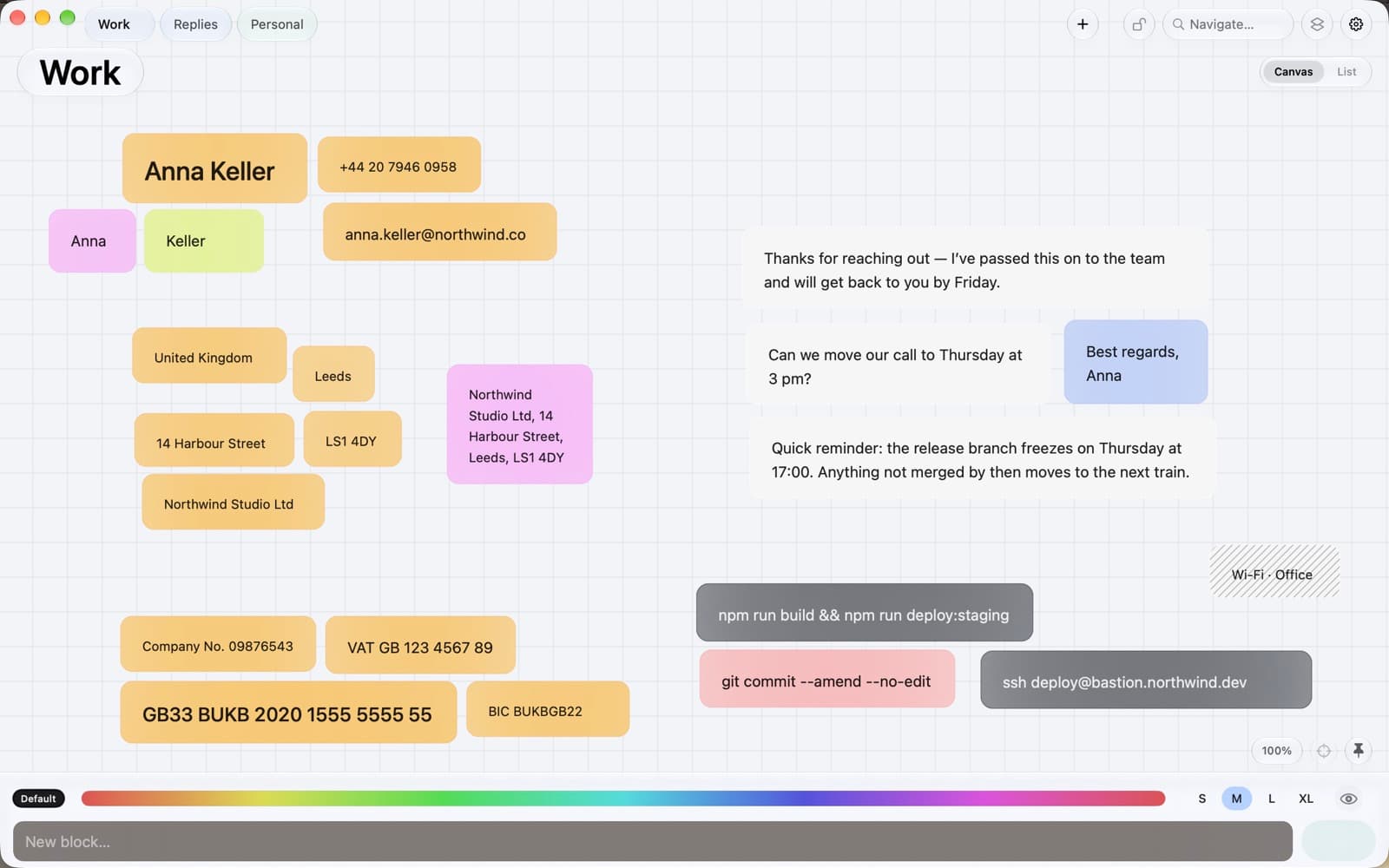
Just click. Just paste. Save any text once, arrange it on a canvas, paste it anywhere as plain text. One universal app for Mac, iPad and iPhone.
- 13 languages, one purchase for all three devices, no subscription
- Three privacy levels per board, up to a passphrase vault on AES-256-GCM
- No account, no server, no analytics: sync runs through the user's own iCloud
Companies I've worked with
- JoeJim: a local AI pre-merge review assistant. First version built in one evening, now used across the engineering team (about 20 developers, front end and back end). It fact-checks its own findings and has a multi-run mode that measures verdict variance. Review cycles typically dropped from 6–8 rounds to 1–2.
- Yoda: a tool for deep audits of complex tasks.
- Audited the UI against the project's component set and revived Storybook. The audit became the framework for UI unification, with execution delegated across the team in peak season.
- Delivered a core internal workflow in six weeks against a 6–9 month estimate.
- Cut the primary dashboard load from ~2 s to 32 ms: first 200 rows in 20 ms, the rest streamed in the background.
- Micro-frontends on Module Federation (PSA pattern); migrated my own module from React 16.8 to 18.
- Built a config-driven form system and AG-Grid / MUI interfaces for real-time financial data.
- Next.js with SSR for a medical data UI.
- A shared table component cut building a new table-based page from about a week to about a day.
- Front-end architecture planning for Sophia Genetics (Next.js SSR).
- Rebuilt a Deloitte internal service for 40+ engineers.
- 90%+ unit test coverage with Jest and React Testing Library.
- Sole front-end developer on Fibonacci.Jobs, taking the MVP from 30% to 70%.
- Accessible registration flows to WCAG 2.1 and EN 301 549; forms adapted for GDPR.
- Front-end for a platform that ran academic competitions and olympiads: studying, turned into a game.
- Started with page layouts and email templates, then React and Redux; moved from jQuery to React full-time in 2018.
What people say
“I had the pleasure of managing Kostiantyn at EPAM, and my experience working with him has been entirely positive. He consistently fulfilled all responsibilities assigned to him with a high level of quality and professionalism. Kostiantyn provided thoughtful feedback both on project matters and during the technical interviews he conducted. He is always positive, focused, and approachable, with a strong ability to learn new technologies quickly while maintaining a broad technical expertise. Throughout our collaboration, there was not a single instance where he missed a deadline — if he committed to completing something by the end of the day, that's exactly when it was done. I can wholeheartedly recommend Kostiantyn as an excellent developer, colleague, and team player.”
Feb 19, 2026— Preeti Indulkar Manager21 yrs exp









The testimonials above are rendered directly from my open-source npm package. A single JSON config drives everything — layout, content, avatars. No backend, no CMS. Drop it into any React app and it just works.
npm install config-driven-testimonialsWhat I work with
Strong
- JavaScript
- TypeScript
- React
- HTML
- CSS
- SCSS
- ReduxThunk / Saga
- MUI
- AG-Grid
- Module Federation
- Feature-Sliced Design
- Config-driven architecture
- Jest
- React Testing Library
- AccessibilityWCAG 2.1
Working
- Next.js
- Tailwind
- Storybook
- GraphQL
- Radix UI
- Playwright
- Zod
- Turborepo
- Webpack
- GitHub Actions
Familiar
- Node.jstooling, npm authoring
- Angularearlier, not current
- SwiftUI
Soft
- Technical writing
- Code review
- Mentoring
- EnglishC1
Let's talk
I'm open to the right opportunity in fintech or enterprise front-end. If you're building something interesting and need someone who thinks about architecture as hard as they think about code — reach out.
keilinkostiantyn@gmail.com